

In response to the increasingly serious deterioration of pipeline infrastructure, various in-pipe inspection devices have been developed in recent years. To enable these devices to travel deep into narrow pipelines, their locomotion mechanisms must not only generate sufficient propulsive force but also prevent slippage against the inner pipe wall. Common approaches include using high-friction materials at the contact surfaces or increasing the pressing force, or normal force, using motors or other actuators to increase the maximum static friction force.
However, in practical pipeline inspection applications, it is essential that the robot can be manually retrieved by pulling its tether cable from the pipe entrance, even in the event of a complete loss of electrical power. This creates a fundamental trade-off: an in-pipe locomotion mechanism designed to provide high traction and resist slipping may also be difficult to retrieve manually during an emergency.
Many existing inspection robots for small-diameter pipes employ snake-like articulated structures, making use of the available space along the pipe axis to incorporate additional functions. Our laboratory’s AIRo series also adopts this approach. Such articulated mechanisms are particularly effective when navigating winding pipe routes. However, when multiple one-degree-of-freedom joints with parallel rotational axes are connected in series, the robot may be geometrically unable to pass through a pipe bend unless the orientation of the robot matches the direction of the bend. Consequently, although these robots provide high self-propelled mobility, retrieving them during an emergency can be extremely difficult.
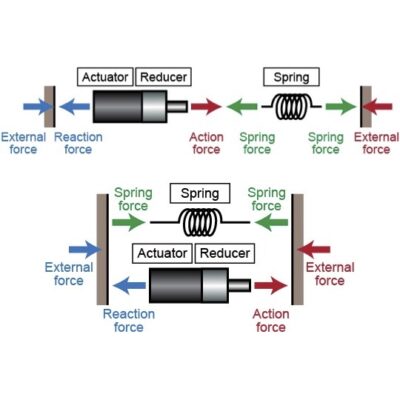
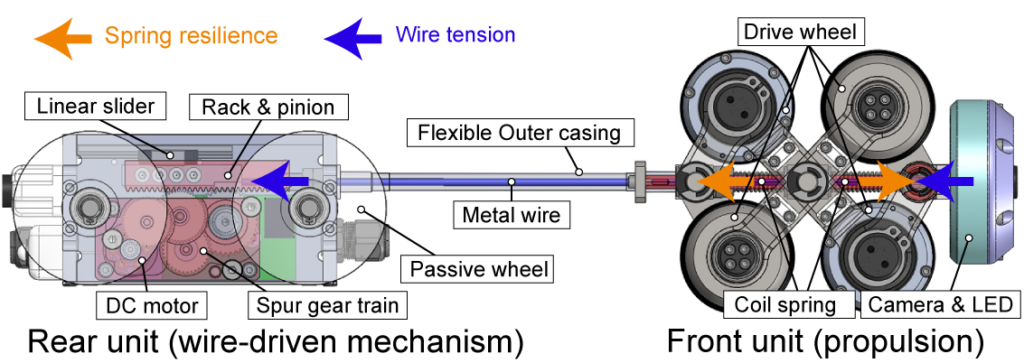
To address this problem, we propose Xbot, a new in-pipe inspection robot designed for emergency retrieval. Xbot combines an X-shaped linkage mechanism, a wire-driven mechanism incorporating a parallel elastic element, and a backdrivable rack-and-pinion mechanism. Although Xbot cannot negotiate vertical T-junctions in the same way as AIRo, its structure enables substantially easier manual retrieval in emergency situations.
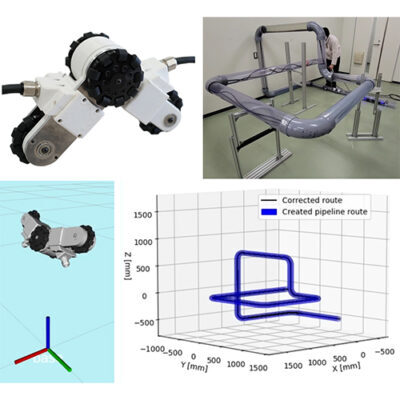
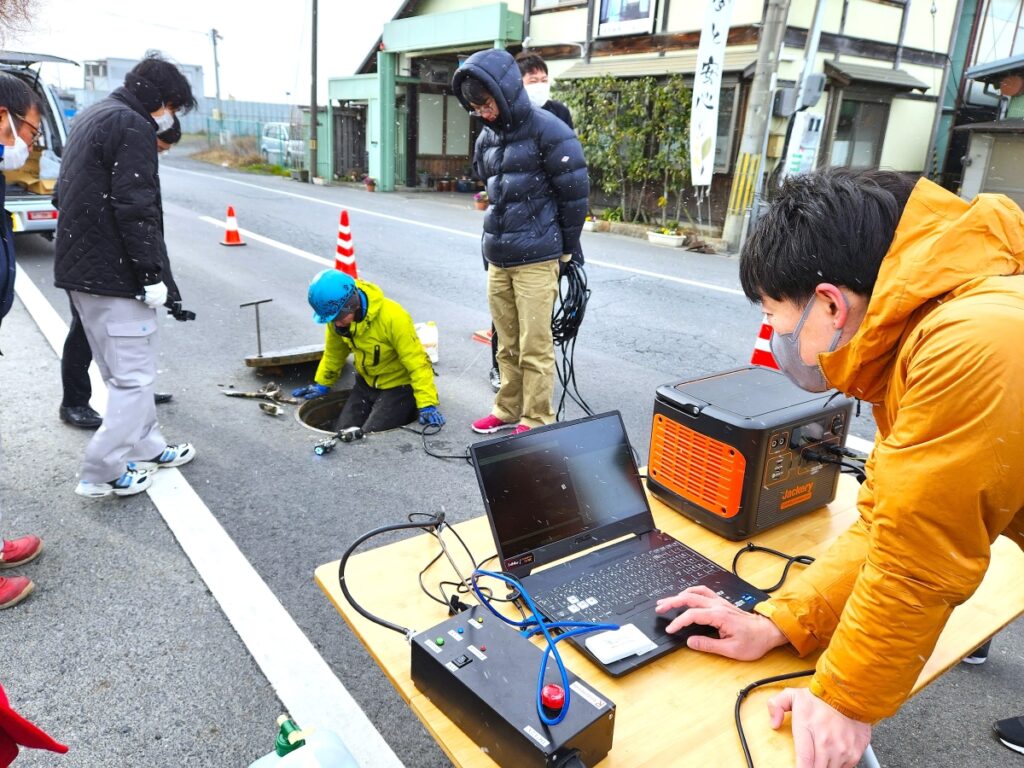
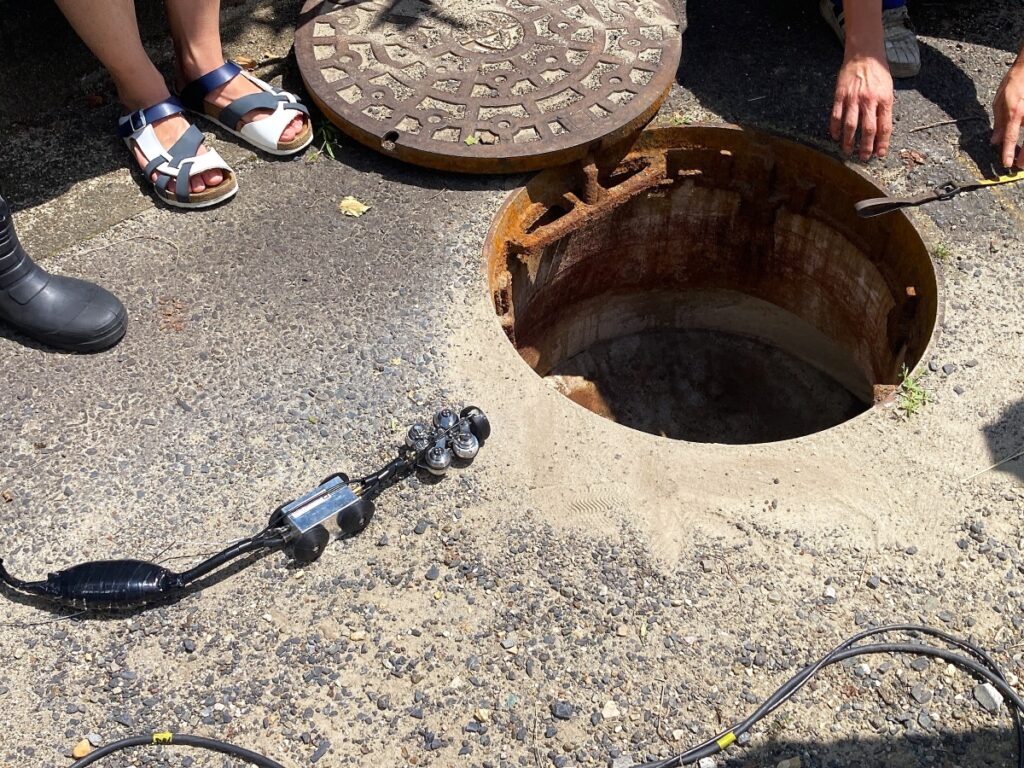
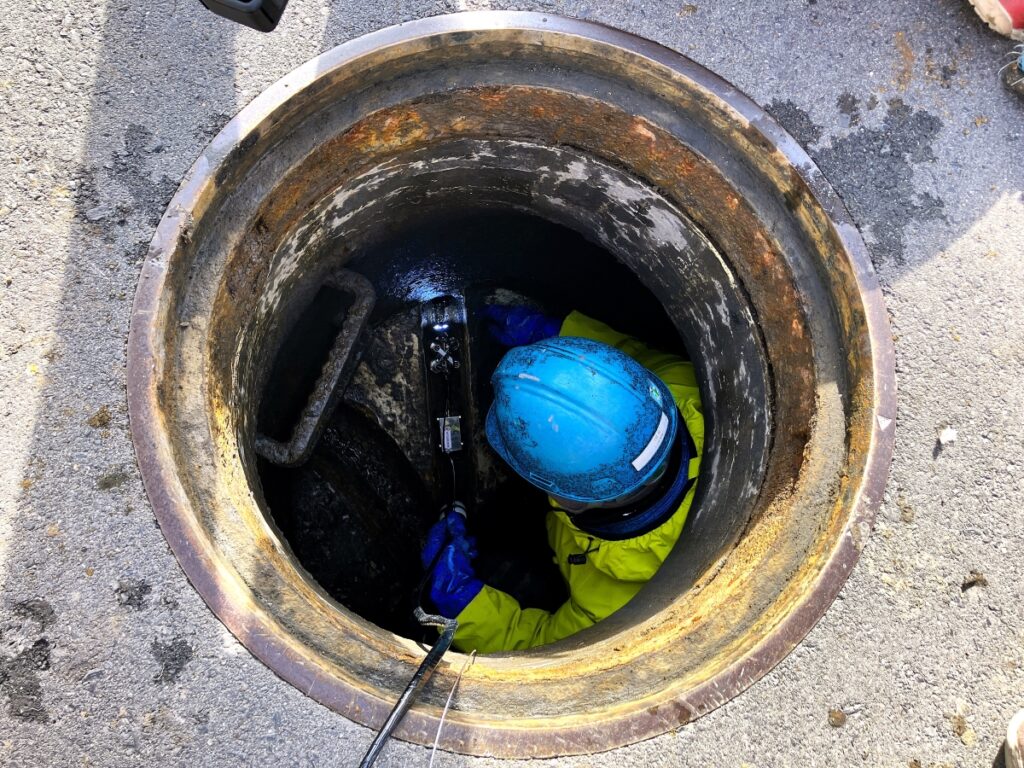
In 2023, we began field demonstration tests of Xbot in an actual 75 mm-diameter sewer force main in Kusatsu City, Shiga Prefecture, Japan. In July 2023, Xbot successfully traveled approximately 20 m through the pipeline and captured video footage of its interior. In January 2024, we also began field testing in the neighboring city of Otsu, Shiga Prefecture.

This research was conducted in collaboration with the National Institute of Advanced Industrial Science and Technology (AIST). It was supported by the FY2022 Shiga Prefecture Subsidy Program for the Social Implementation of Near-Future Technologies, the Ritsumeikan Impact-Makers Inter X (Cross) Platform Commercialization Grant, and the AIST–Ritsumeikan University Seeds Integration and Sprout Program. We gratefully acknowledge the support of the Water Supply and Sewerage Facilities Division of Kusatsu City and the Sewer Pipeline Division of Daigo Sangyo Co., Ltd. during the field demonstration tests.
Related Publications
- Atsushi Kakogawa, Ryota Taniguchi, and Tomonari Yamamoto, “Development of a 3 in Sewer Pipe Inspection Robot with a Wire-driven Parallel Elastic Actuator for Emergency Evacuation,” The 2024 IEEE International Conference on Real-time Computing and Robotics (RCAR 2025), pp. 691–696, 2025.
- Atsushi Kakogawa, “Self-Propelled Robotic Technology for the Inspection of Sewer Force Mains,” Journal of Japan Sewage Works Association, Vol. 61, No. 746, pp. 44–47, December 2024. [in Japanese]
- Atsushi Kakogawa, “Development of an Inspection Robot and a Pipeline Route Mapping System for Sewer Force Mains,” Journal of Sewerage, Special Issue: Sewerage Technologies for the Future, Vol. 47, No. 7, June 2024. [in Japanese]
- Atsushi Kakogawa and Tomonari Yamamoto, “Development of ‘Xbot 1,’ a Three-Inch Pipe Inspection Robot with a Wire-Driven Extending and Contracting Mechanism for Emergency Retrieval,” Proceedings of the 2023 JSME Conference on Robotics and Mechatronics, 1A1-B12, 2023. [in Japanese]