

Our previous research on the M-shaped articulated structure demonstrated that extending the joints against the inner pipe wall maintains continuous contact between the wheels and the pipe surface. This structure provides excellent adaptability to bends and T-junctions as well as high traction performance. In addition, by arranging the wheel axes and joint axes coaxially, the links can achieve a large range of motion, allowing the robot to adapt to a wide range of pipe diameters.
However, articulated structures consisting of three, four, or more links were unable to negotiate out-of-plane bends. Several robots capable of traveling through such bends have already been reported, but many employ a configuration in which multiple drive units equipped with small-diameter wheels are connected by passive joints. Because the diameter-expansion mechanism incorporated into each individual drive unit has a limited range of motion, these robots can accommodate only a relatively narrow range of pipe diameters.
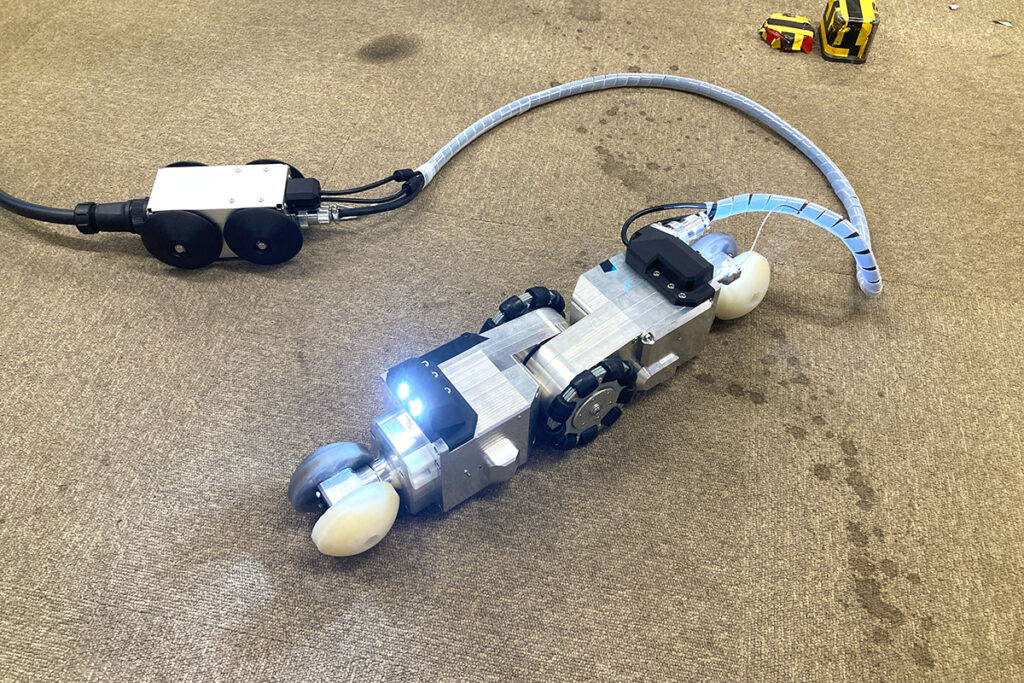
To address this limitation, we proposed AIRo-6.3, a V-shaped in-pipe inspection robot that can negotiate out-of-plane bends while retaining the wide diameter-adaptation range of a linked-wheel mechanism. Although its adaptability to T-junctions is lower than that of the M-shaped structure, AIRo-6.3 can travel through closely spaced and continuously connected bends, including out-of-plane bends and inverted siphons, without requiring complicated control operations.
AIRo-6 Series
The AIRo-6 series was developed for the inspection of medium-diameter pipelines with an internal diameter of approximately 8 inches, or 200 mm.
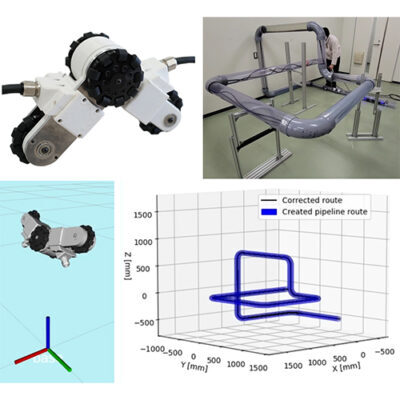
Although its external configuration is similar to that of the AIRo-3 series described below, the AIRo-6 series incorporates actively driven joints. The joints can be bent using motors, allowing the wheels to press more firmly against the pipe wall and reducing slippage. We also eliminated the differential mechanism previously used for the front and rear spherical wheels. Translational motion and rolling rotation are instead driven independently by two separate motors. Tests conducted in steel pipes confirmed that the robot could successfully negotiate out-of-plane bends and inverted siphons.
In 2023, we conducted a field demonstration in an underground gas pipeline at a site in Osaka Prefecture, Japan. After entering a vertical section of the pipeline, the robot successfully inspected approximately 25 m of the buried pipe.
The AIRo-6 series was developed through commissioned research funded by Nippon Steel Pipeline & Engineering Co., Ltd.
Related Publications
- Atsushi Kakogawa, Kanade Sekiya, Ryota Nakazawa, and Yasuyuki Ikuno, “A V-Shaped In-Pipe Robot to Travel through Complex Winding Pathways in Three Dimensions,” Journal of Field Robotics, Vol. 42, No. 5, pp. 1808–1825, 2024.
- Kanade Sekiya, Atsushi Kakogawa, Ryota Nakazawa, and Yasuyuki Ikuno, “Development and Field Testing of a Practical V-Shaped In-Pipe Inspection Robot,” Proceedings of the 42nd Annual Conference of the Robotics Society of Japan, 2024. [in Japanese]
- Kanade Sekiya, Chihiro Hirose, Kenya Murata, Yuki Kobayashi, Atsushi Kakogawa, and Shugen Ma, “Development of a V-Shaped In-Pipe Inspection Robot Capable of Negotiating Out-of-Plane Bends,” Proceedings of the 2023 JSME Conference on Robotics and Mechatronics, 1A1-B13, 2023. [in Japanese]
AIRo-3 Series
The AIRo-3 series served as the original prototype for the AIRo-6 series. It employs the V-shaped structure described above and is designed for pipes with an internal diameter of approximately 4 inches, or 100 mm. Its joints are passively bent by springs, while a simple bevel-gear differential mechanism is incorporated into the front and rear spherical wheels. This mechanism enables a single motor to generate both translational motion for forward and backward travel and rolling motion about the robot’s longitudinal axis. The direction of motor rotation determines which of these two motions is produced.
Related Publications
- Yoshimichi Oka, Atsushi Kakogawa, Yang Tian, and Shugen Ma, “Control Technique of a V-Shaped In-Pipe Robot Composed of Two Underactuated Roll-Pitch Joints,” Advanced Robotics, Vol. 36, No. 4, pp. 205–216, 2021.
- Yoshimichi Oka, Atsushi Kakogawa, and Shugen Ma, “A Wheeled V-Shaped In-Pipe Robot with Clutched Underactuated Joints,” Proceedings of the IEEE International Conference on Robotics and Automation (ICRA 2021), pp. 11457–11462, 2021.
- Yoshimichi Oka, Atsushi Kakogawa, and Shugen Ma, “Stopper Angle Design for a Multi-Link Articulated Wheeled In-Pipe Robot with Underactuated Twisting Joints,” Proceedings of the IEEE/RSJ International Conference on Intelligent Robots and Systems (IROS 2018), pp. 973–978, 2018.
- Atsushi Kakogawa, Yoshimichi Oka, and Shugen Ma, “Multi-Link Articulated Wheeled In-Pipe Robot with Underactuated Twisting Joints,” Proceedings of the IEEE International Conference on Mechatronics and Automation (ICMA 2018), pp. 942–947, 2018.
- Yoshimichi Oka, Atsushi Kakogawa, and Shugen Ma, “Development of a Linked-Wheel In-Pipe Mobile Robot with a Differential Mechanism between the Wheel and Body Axes,” Proceedings of the 2017 JSME Conference on Robotics and Mechatronics, 2A2-A10, 2017. [in Japanese]